How Many Square Feet for a Baby Macaw
Macaw
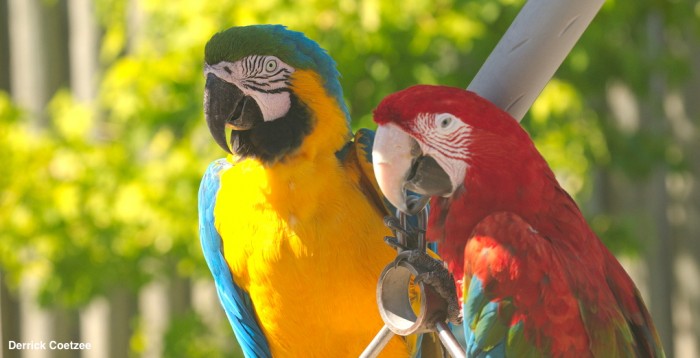
Blue and gold macaw (Ara ararauna) (left); dark-green-winged macaw (Ara chloropterus )(right)
Natural history
Macaws are plant in a variety of habitats throughout large areas of the Amazon Basin, such every bit gallery forests and mangrove swamps. Most macaws are listed on Convention on International Trade in Endangered Species (CITES) Appendix I, however the blue and gold, green-winged, Hahn'south, noble, ruddy-bellied, astringent and yellowish-collared macaws are listed on CITES Appendix II. Appendix I species are threatened with extinction globally, and commercial merchandise is prohibited and importation/exportation for scientific research requires special permits. Appendix II species are not necessarily threatened with extinction, only may become so unless their merchandise is strictly regulated.
Taxonomy
Grade: Aves
Order: Psittaciformes
Family: Psittacidae
Anodorhynchus hyacinthinus – hyacinth macaw
Ara spp.
Ara ararauna – blueish and aureate macaw
Ara chloropterus – green-winged macaw
Ara macao – cherry-red macaw
Diopsittaca nobilis – D. north. cumanensis – noble macaw
There are fifteen species of macaws in the genus Ara and iii species in genus Anodorhynchus. Blueish and gold, scarlet, and greenish-winged macaws are among the near popular pet macaw species. Visit LafeberVet's Macaw ID Slideshow for boosted information.
Concrete description
- Macaws are slender birds with long tapered tails; strong, heavy bills; and a bare facial patch.
- Macaws are sexually monomorphic.
- The green-winged macaw may be distinguished from the scarlet macaw by its larger size and the bands of pocket-size, scarlet feathers around the eyes. Scarlet macaws also have yellow feathers on their wings.

Scarlet macaws (Ara macao). Image by Dunleavy. Click epitome to overstate
Nutrition
- Macaws are frugivores, granivores, and/or florivores. Free-ranging birds feed on seeds, fruit, figs, palm basics, leaves, nectar, and/or flowers.
- Some macaws need more than fat in their diet. Hyacinth macaws swallow only palm basics in the wild.
- Since psittacine birds hull seeds before ingestion, they do not require grit. In fact, some individuals will overeat grit when ill putting the bird at risk for impaction.
- All-seed diets are scarce in protein, vitamins, and minerals including calcium and vitamin A.
Husbandry
- Macaws crave a big amount of space in a quality made cage or room with appropriate toys.
- Cage bar spacing should be 0.75-1.v in (i.nine-3.8 cm).
- Perch diameter should range from 5/viii in (1.six cm) for Hahn's macaw upwards to 2 in (5 cm) for hyacinth macaws.
- Provide frequent baths or showers.
Behavior
- Most of the large macaws are considered gentle birds, withal all large macaws can be quite noisy and subversive.
- The blood-red macaw has a reputation for a particularly stiff personality making them a hard pet for inexperienced owners.
- All macaws are extremely intelligent that require a lot of stimulation.
- Feather subversive beliefs may exist more than mutual in some of the mini macaw species.
- Well-nigh macaw species have a bare facial area, which can flush pink indicating a change in mood.
- Foraging is an of import office of normal daily parrot activity. Teach and encourage pet birds to play and forage.
Normal physiologic values
| Temperature (average)* | 42°C | 107.7°F |
| Heart rate (beats/min) | Small Macaws | 389 |
| Large Macaws | 275 | |
| Respiration (breaths/min) | 20-25 | |
| Average body weight (g) | Hahn's | 120-160 |
| Armed forces | 900 | |
| Crimson | 900-1000 | |
| Blueish and Gold | 900-1300 | |
| Green-Winged | 1200-1600 | |
| Hyacinth | 1250-1695 | |
| Hateful life span (years) | Small Macaws | 20-25 (35 reported) |
| Large Macaws | 30-45 (75-100 possible) | |
| Sexual maturity | Modest Macaws | 4-half dozen years |
| Big Macaws | 5-7 years | |
| Mean number of incubation days | 23-28 | Longer for larger birds |
| Average number of eggs laid | 1-3 | |
| Weaning age (days) | Small Macaws | ninety-120 – parent raised |
| Large Macaws | 120-150 – parent raised | |
| Target environmental temperature | Mimic natural environs. | Household temperatures of 70-lxxx°F (21-27°C) are generally adequate, even so salubrious birds tin can tolerate hot and common cold temperatures. |
| *Routine avian examination does non include measuring trunk temperature | ||
Anatomy and physiology
- Macaws take a rolling or waddling gait due to walking on their anxiety as well equally caudal tarsometatarsus.
- The pressure exerted by a large macaw beak tin be greater than 200 psi.
- Macaws share the following anatomic traits with other members of Club Psittaciformes:
- Advice of the right and left nasal sinus
- The only avian tongue with intrinsic muscles
- Simply syrinx
- Craniofacial swivel of beak is a synovial joint
- Ceca absent-minded
- Gall bladder oft absent-minded
- Zygodactyl human foot: two toes pointed backward and ii pointed forward
Restraint
- Most macaw species accept a bare facial patch that tin flush pink colour indicating a alter in mood.
- Restrain large macaws by placing the thumb and forefinger beneath the mandible. Secure the outside wing with three fingers and apply the other hand to hold the anxiety.
- Avert touching the bare facial patch as the skin can bruise subsequently aggressive restraint.
Venipuncture
Use a 25-gauge needle and 1 to 3-mL syringe to draw blood from the right jugular vein. Collection of up to 1% of trunk weight is acceptable in good for you patients.
Preventive medicine
- Obtain a complete history and perform a thorough almanac concrete examination.
- Establish baseline data with regular clinical testing (complete blood count, protein electrophoresis, and plasma biochemistries.
- Ensure proper diet and husbandry.
- Recommend quarantine of newly acquired birds.
- Perform boosted testing for select diseases based on history and physical exam findings: avian polyoma virus and psittacosis.
- Determine origin and history of newly acquired sick birds to contain and prevent further spread of disease.
- Birds housed in large groups or aviaries are at college gamble of Pacheco's disease virus and utilize of the vaccine may be indicated.
- The avian polyoma virus vaccine is recommended for convenance populations.
Injections
| Intramuscular (IM) | Reasonably safety, most authentic. Inject middle of muscle mass. | Ideal location –Pectoral muscle mass |
| Subcutaneous (SQ) | Large volumes can be injected, poor absorption. | Location: Inguinal or precrural fold |
| Intravenous | Effective, narrow rubber range. | Right jugular vein or brachial vein is about ordinarily used. Alternative pick: superficial metatarsal vein. |
Important medical conditions
Non-Infectious Diseases
- Aspergillosis
- Atherosclerosis
- Nib malocclusion
- Degenerative cardiac disease
- Feather destructive behavior in some mini macaw species
- Goiter
- Inflammatory skin disease
- Internal papillomatosis
- Respiratory disease including pulmonary hypersensitivity syndrome or allergic pneumonitis: The incidence of respiratory disease increases in birds exposed to low relative humidity and/or birds that produce lots of powder down such as cockatoos.
- Yolk peritonitis
Infectious Diseases
- Oral abscesses
- Avian bornavirus infection (proventricular dilitation affliction or PDD)
- Avian polyomavirus
**Login to view references**
References
References
Beynon P (ed). BSAVA Manual of Psittacine Birds. Ames, Iowa: Iowa State University Press, 1996. 7-9, 37.
Carpenter J (ed). Exotic Animal Formulary. 3rd ed. St. Louis, MO; Elsevier Saunders; 2005. Pp. 278-279.
Convention on International Trade in Endangered Species of Wildlife and Flora. Appendices I, II, and III. Valid from Apr 27, 2011. Available at: http://world wide web.cites.org/eng/app/appendices.php. Accessed June 8, 2011.
Finkelstein A. Normal cloacal temperatures in multiple avian species. Proc Annu Conf Assoc Avian Vet; 2004. P. 383.
Doneley B, Harrison GJ, Lightfoot TL. Maximizing information from the physical test. In: Harrison GJ, Lightfoot TL (eds). Clinical Avian Medicine. Palm Beach, FL: Spix Publishing; 2006. P. 173.
Garner MM. A retrospective written report of diseases in captive macaws. Proc Annu Conf Assoc Avian Vet 2010. Pp. 43.
Harcourt-Brownish N, Chitty J (eds). BSAVA Manual of Psittacine Birds, 2d ed. Quedgeley, Glouchester: British Small Animal Veterinary Clan; 2005. Pp. 4-seven, nine, 11, 27.
Harrison GJ, Lightfoot TL (eds). Clinical Avian Medicine. Palm Embankment, FL; Spix Publishing; 2006. Pp.174, 387, 583-585.
Koustos EA, Matson KD, Klasing KC. Nutrition of birds in the guild Psittaciformes: a review. J Avian Med Surg15(4):257-275, 2001.
Lafeber Company. The Macaw Parrot. Lafeber Pet Birds Web site. Available at: http://lafeber.com/pet-birds/species/macaw/. Accessed May 15, 2011.
Depression R. Parrots in aviculture: A photoreference guide. Pickering, Ontario; Silvio Mattachione & Co; 1992. P. 82.
Morgan D. Bird Care. Neptune City, NJ: TFH Publications; 2005. Pp. fifteen-xvi, 17-18.
O'Malley B. Clinical Beefcake and Physiology of Exotic Species. Edinburgh: Elsevier Saunders; 2005. Pp. 156-157.
Schmidt RE, Reavill DR. Thyroid hyperplasia in birds. J Avian Med Surg 16(two):111-114, 2002.
Tully TN. Birds. In: Mitchell M, Tully TN (eds). Manual of Exotic Pet Practice. St. Louis, MO: Saunders; 2008. Pp. 262, 270-271, 276.
Tully TN, Lawton MPC, Dorrestein GM. Avian Medicine. Oxford: Butterworth-Heinemann, 2000. Pp. 26-34, 43-51.
To cite this folio:
Pollock C. Basic information sheet: Macaw. January 8, 2012. LafeberVet Web site. Available at https://lafeber.com/vet/bones-information-sheet-for-the-macaw/
jenningsoppoichest.blogspot.com
Source: https://lafeber.com/vet/basic-information-sheet-for-the-macaw/
0 Response to "How Many Square Feet for a Baby Macaw"
Post a Comment