Make America Great Again Build the Wall
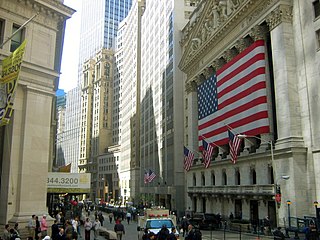 The New York Stock Commutation Building's Broad Street entrance (correct) as seen from Wall Street | |||
 | |||
| West end | Broadway | ||
|---|---|---|---|
| East end | South Street | ||
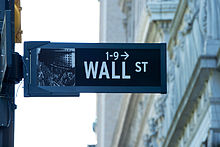
Wall Street is an eight-cake-long street in the Financial District of Lower Manhattan in New York City. Information technology runs between Broadway in the due west to South Street and the East River in the east. The term "Wall Street" has become a metonym for the financial markets of the United States every bit a whole, the American financial services manufacture, New York–based financial interests, or the Financial District itself.
Wall Street was originally known in Dutch as "de Waalstraat" when it was part of New Amsterdam in the 17th century, though the origins of the proper noun vary. An bodily wall existed on the street from 1685 to 1699. During the 17th century, Wall Street was a slave trading marketplace and a securities trading site, every bit well equally the location of Federal Hall, New York'due south showtime metropolis hall. In the early 19th century, both residences and businesses occupied the area, but increasingly concern predominated, and New York City's financial industry became centered on Wall Street. In the 20th century, several early skyscrapers were built on Wall Street, including 40 Wall Street, once the globe'due south tallest building.
The Wall Street surface area is dwelling to the New York Stock Exchange, the world's largest stock exchange by total marketplace capitalization, as well as the Federal Reserve Bank of New York, and many commercial banks and insurance companies. Several other stock and commodity exchanges have also been located in downtown Manhattan near Wall Street, including the New York Mercantile Substitution and other commodity futures exchanges, and the American Stock Exchange. To back up the business they did on the exchanges, many brokerage firms had offices nearby. However the direct economic impacts of Wall Street activities extend worldwide.
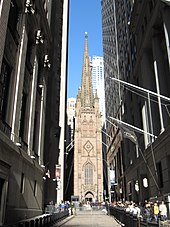
Wall Street itself is a narrow winding street running from the Eastward River to Broadway and lined with skyskrapers, as well as the New York Stock Exchange Building and Federal Hall National Memorial and One Wall Street at its western end. The street is nearby multiple subway lines and ferry terminals and the World Trade Centre (1973–2001) site.
History [edit]
Early on years [edit]
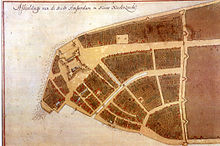
The original city map chosen the Castello Plan from 1660, showing the wall on the right side
There are varying accounts nearly how the Dutch-named "de Waalstraat"[1] (literally: Walloon Street) got its name. Two conflicting explanations tin be considered.
I explanation maintains that Wall Street was named afterwards Walloons, the Dutch proper noun for a Walloon being Waal.[ii] Among the outset settlers that embarked on the ship Nieu Nederlandt in 1624 were 30 Walloon families. In 1626, Peter Minuit, the governor of the colony, who became famous by the purchase of Manhattan Island for the Dutch West India Company, was a Walloon.[three]
The other is that the name of the street was derived from a wall or rampart (actually a wooden palisade) on the northern purlieus of the New Amsterdam settlement, built to protect against potential incursions from Native Americans, pirates, and the English language. The wall was built of dirt and 15-foot (four.6 m) wooden planks, measuring two,340 feet (710 m) long and nine feet (2.7 g) alpine.[4]
While the Dutch give-and-take "wal" can be translated as "rampart", it just appeared equally "De Wal Straat" on some English maps of New Amsterdam, whereas other English maps show the name as "De Waal Straat".[ane]
According to one version of the story:
The red people from Manhattan Isle crossed to the mainland, where a treaty was made with the Dutch, and the place was therefore called the Piping of Peace, in their linguistic communication, Hoboken. But soon after that, the Dutch governor, Kieft, sent his men out there one night and massacred the entire population. Few of them escaped, just they spread the story of what had been done, and this did much to antagonize all the remaining tribes confronting all the white settlers. Soon after, Nieuw Amsterdam erected a double palisade for defence against its now enraged red neighbors, and this remained for some time the northern limit of the Dutch city. The space betwixt the former walls is now called Wall Street, and its spirit is still that of a bulwark against the people.[v]
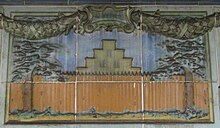
Depiction of the wall of New Amsterdam on a tile in the Wall Street subway station, serving the 4 and v trains
In the 1640s, bones picket and plank fences denoted plots and residences in the colony.[6] Later, on behalf of the Dutch West India Company, Peter Stuyvesant, using both enslaved Africans and white colonists, collaborated with the urban center regime in the construction of a more substantial fortification, a strengthened 12-foot (iv g) wall.[7] [8] In 1685, surveyors laid out Wall Street forth the lines of the original stockade.[ix] The wall started at Pearl Street, which was the shoreline at that time, crossing the Indian path Broadway and catastrophe at the other shoreline (today's Trinity Place), where it took a turn south and ran along the shore until it ended at the old fort. In these early days, local merchants and traders would gather at disparate spots to buy and sell shares and bonds, and over time divided themselves into two classes—auctioneers and dealers.[10] Wall Street was also the market place where owners could hire out their slaves by the day or calendar week.[eleven] The rampart was removed in 1699[2] [4] and a new Metropolis Hall built at Wall and Nassau in 1700.
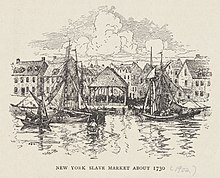
New York Urban center slave market about 1730
Slavery was introduced to Manhattan in 1626, but it was non until December 13, 1711, that the New York Metropolis Mutual Council fabricated Wall Street the metropolis's first official slave market for the sale and rental of enslaved Africans and Indians.[12] [xiii] The slave market place operated from 1711 to 1762 at the corner of Wall and Pearl Streets. Information technology was a wooden structure with a roof and open up sides, although walls may take been added over the years and could hold approximately fifty men. The metropolis straight benefited from the sale of slaves past implementing taxes on every person who was bought and sold there.[fourteen]
In the tardily 18th century, there was a buttonwood tree at the foot of Wall Street nether which traders and speculators would gather to trade securities. The do good was being in proximity to each other.[15] [4] In 1792, traders formalized their association with the Buttonwood Agreement which was the origin of the New York Stock Exchange.[sixteen] The idea of the agreement was to make the market more "structured" and "without the manipulative auctions", with a committee structure.[10] Persons signing the understanding agreed to charge each other a standard commission rate; persons not signing could still participate only would be charged a higher committee for dealing.[ten]

An engraving from 1855, showing a conjectural view of Wall Street, including the original Federal Hall, as it probably looked at the time of George Washington'south inauguration, 1789.
In 1789, Wall Street was the scene of the United States' first presidential inauguration when George Washington took the oath of office on the balcony of Federal Hall on April 30, 1789. This was likewise the location of the passing of the Bill Of Rights. Alexander Hamilton, who was the outset Treasury secretary and "architect of the early on The states fiscal organisation", is buried in the cemetery of Trinity Church, as is Robert Fulton famed for his steamboats.[17] [18]
19th century [edit]
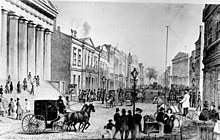
In the first few decades, both residences and businesses occupied the area, but increasingly business concern predominated. "In that location are old stories of people's houses being surrounded by the clamor of business and trade and the owners lament that they can't get anything done," according to a historian named Burrows.[nineteen] The opening of the Erie Culvert in the early 19th century meant a huge boom in business for New York City, since it was the only major eastern seaport which had directly access past inland waterways to ports on the Peachy Lakes. Wall Street became the "money upper-case letter of America".[xv]
Historian Charles R. Geisst suggested that there has constantly been a "tug-of-war" between business organization interests on Wall Street and authorities in Washington, D.C., the capital letter of the United States by and then.[10] Generally during the 19th century Wall Street adult its own "unique personality and institutions" with little exterior interference.[ten]
In the 1840s and 1850s, most residents moved further uptown to Midtown Manhattan because of the increased business use at the lower tip of the island.[19] The Ceremonious War had the effect of causing the northern economy to smash, bringing greater prosperity to cities like New York which "came into its own as the nation's banking center" connecting "Old World capital letter and New World ambition", according to i business relationship.[17] J. P. Morgan created behemothic trusts; John D. Rockefeller's Standard Oil moved to New York.[17] Between 1860 and 1920, the economic system inverse from "agronomical to industrial to fiscal" and New York maintained its leadership position despite these changes, according to historian Thomas Kessner.[17] New York was second but to London as the world's fiscal capital.[17]
In 1884, Charles Dow began tracking stocks, initially beginning with 11 stocks, by and large railroads, and looked at average prices for these xi.[20] Some of the companies included in Dow'due south original calculations were American Tobacco Company, General Electric, Laclede Gas Company, National Lead Visitor, Tennessee Coal & Iron, and U.s.a. Leather Company.[21] When the average "peaks and troughs" went up consistently, he accounted it a bull market status; if averages dropped, information technology was a bear market. He added up prices, and divided by the number of stocks to get his Dow Jones average. Dow's numbers were a "convenient benchmark" for analyzing the market and became an accepted way to look at the entire stock marketplace. In 1889 the original stock report, Customers' Afternoon Letter, became The Wall Street Journal. Named in reference to the actual street, it became an influential international daily business newspaper published in New York City.[22] After Oct 7, 1896, it began publishing Dow's expanded list of stocks.[20] A century later, there were 30 stocks in the average.[21]
20th century [edit]
Early on 20th century [edit]

Wall Street bombing, 1920. Federal Hall National Memorial is at the right.
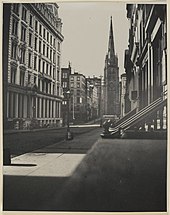
Business concern author John Brooks in his volume Once in Golconda considered the showtime of the 20th century period to have been Wall Street's heyday.[17] The address of 23 Wall Street, the headquarters of J. P. Morgan & Visitor, known every bit The Corner, was "the precise center, geographical every bit well equally metaphorical, of financial America and fifty-fifty of the financial earth".[17]
Wall Street has had changing relationships with government authorities. In 1913, for instance, when authorities proposed a $four stock transfer revenue enhancement, stock clerks protested.[23] At other times, urban center and land officials have taken steps through revenue enhancement incentives to encourage financial firms to continue to do business in the city.
A mail service office was built at 60 Wall Street in 1905.[24] During the World War I years, occasionally there were fund-raising efforts for projects such as the National Baby-sit.[25]
On September sixteen, 1920, close to the corner of Wall and Broad Street, the busiest corner of the Financial District and across the offices of the Morgan Banking concern, a powerful bomb exploded. It killed 38 and seriously injured 143 people.[26] The perpetrators were never identified or apprehended. The explosion did, withal, help fuel the Ruby Scare that was underway at the time. A report from The New York Times:
The tomb-like silence that settles over Wall Street and lower Broadway with the coming of night and the suspension of business was entirely changed last night every bit hundreds of men worked under the glare of searchlights to repair the harm to skyscrapers that were lighted up from top to lesser. ... The Assay Part, nearest the signal of explosion, naturally suffered the most. The front was pierced in fifty places where the cast iron slugs, which were of the material used for window weights, were thrown against it. Each slug penetrated the stone an inch or 2 and chipped off pieces ranging from 3 inches to a pes in diameter. The ornamental fe grill work protecting each window was broken or shattered. ... the Assay Office was a wreck. ... It was as though some gigantic forcefulness had overturned the building and and so placed it upright once again, leaving the framework uninjured but scrambling everything inside.
—1920[27]
The expanse was subjected to numerous threats; one bomb threat in 1921 led to detectives sealing off the area to "prevent a repetition of the Wall Street flop explosion".[28]
Regulation [edit]
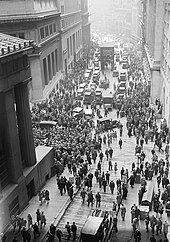
September 1929 was the summit of the stock marketplace.[29] October 3, 1929 was when the market started to slip, and it continued throughout the week of October 14.[29] In Oct 1929, renowned Yale economist Irving Fisher reassured worried investors that their "money was safe" on Wall Street.[xxx] A few days afterward, on October 24,[29] stock values plummeted. The stock market crash of 1929 ushered in the Great Depression, in which a quarter of working people were unemployed, with soup kitchens, mass foreclosures of farms, and falling prices.[thirty] During this era, development of the Financial District stagnated, and Wall Street "paid a heavy cost" and "became something of a backwater in American life".[30]
During the New Bargain years, likewise as the 1940s, there was much less focus on Wall Street and finance. The government clamped down on the practice of buying equities based only on credit, merely these policies began to ease. From 1946 to 1947, stocks could not be purchased "on margin", pregnant that an investor had to pay 100% of a stock's price without taking on any loans.[31] However, this margin requirement was reduced four times before 1960, each fourth dimension stimulating a mini-rally and boosting book, and when the Federal Reserve reduced the margin requirements from xc% to 70%.[31] These changes made information technology somewhat easier for investors to buy stocks on credit.[31] The growing national economy and prosperity led to a recovery during the 1960s, with some down years during the early 1970s in the aftermath of the Vietnam War. Trading volumes climbed; in 1967, co-ordinate to Fourth dimension Magazine, book hit 7.5 million shares a mean solar day which caused a "traffic jam" of newspaper with "batteries of clerks" working overtime to "articulate transactions and update customer accounts".[32]
In 1973, the fiscal community posted a collective loss of $245 million, which spurred temporary assist from the authorities.[33] Reforms were instituted; the Securities & Exchange Commission eliminated fixed commissions, which forced "brokers to compete freely with one another for investors' concern".[33] In 1975, the SEC threw out the NYSE's "Rule 394" which had required that "nigh stock transactions take identify on the Big Board's floor", in issue freeing upward trading for electronic methods.[34] In 1976, banks were allowed to buy and sell stocks, which provided more than competition for stockbrokers.[34] Reforms had the effect of lowering prices overall, making information technology easier for more people to participate in the stock market.[34] Banker commissions for each stock sale lessened, but volume increased.[33]
The Reagan years were marked past a renewed push for capitalism and business concern, with national efforts to de-regulate industries such every bit telecommunication and aviation. The economy resumed upward growth later on a period in the early 1980s of languishing. A report in The New York Times described that the flushness of coin and growth during these years had spawned a drug culture of sorts, with a rampant acceptance of cocaine use although the overall percent of bodily users was most likely pocket-sized. A reporter wrote:
The Wall Street drug dealer looked like many other successful young female person executives. Stylishly dressed and wearing designer sunglasses, she sat in her 1983 Chevrolet Camaro in a no-parking zone across the street from the Marine Midland Banking concern branch on lower Broadway. The client in the passenger seat looked like a successful young businessman. But every bit the dealer slipped him a oestrus-sealed plastic envelope of cocaine and he passed her cash, the transaction was being watched through the sunroof of her car past Federal drug agents in a nearby edifice. And the customer — an undercover amanuensis himself -was learning the ways, the wiles and the conventions of Wall Street's drug subculture.
In 1987, the stock market plunged,[15] and, in the relatively cursory recession post-obit, the surrounding area lost 100,000 jobs according to one estimate.[36] Since telecommunications costs were coming downwardly, banks and brokerage firms could motion away from the Financial District to more affordable locations.[36] Ane of the firms looking to movement away was the NYSE. In 1998, the NYSE and the city struck a $900 million bargain which kept the NYSE from moving across the river to Bailiwick of jersey City; the deal was described as the "largest in city history to prevent a corporation from leaving town".[37]
21st century [edit]
In 2001, the Big Board, as some termed the NYSE, was described every bit the world'south "largest and most prestigious stock market".[38] When the World Merchandise Centre was destroyed on September xi, 2001, the attacks "crippled" the communications network and destroyed many buildings in the Financial Commune, although the buildings on Wall Street itself saw only fiddling physical damage.[38] I estimate was that 45% of Wall Street'due south "best office infinite" had been lost.[fifteen] The NYSE was adamant to re-open on September 17, almost a week after the assail.[39] During this time Rockefeller Group Concern Heart opened additional offices at 48 Wall Street. Still, after September 11, the financial services industry went through a downturn with a sizable drop in year-terminate bonuses of $6.5 billion, according to one approximate from a state comptroller's part.[40]
To guard against a vehicular bombing in the expanse, authorities built concrete barriers, and constitute means over fourth dimension to make them more aesthetically highly-seasoned by spending $5000 to $8000 apiece on bollards. Parts of Wall Street, likewise every bit several other streets in the neighborhood, were blocked off by specially designed bollards:
... Rogers Marvel designed a new kind of bollard, a faceted slice of sculpture whose broad, slanting surfaces offer people a identify to sit down in contrast to the typical bollard, which is supremely unsittable. The bollard, which is called the Nogo, looks a bit like i of Frank Gehry's unorthodox civilization palaces, but it is hardly insensitive to its surroundings. Its bronze surfaces really repeat the grand doorways of Wall Street's temples of commerce. Pedestrians easily slip through groups of them as they brand their style onto Wall Street from the surface area around historic Trinity Church. Cars, still, cannot pass.
The Guardian reporter Andrew Clark described the years of 2006 to 2010 as "tumultuous", in which the heartland of America was "mired in gloom" with high unemployment around 9.6%, with boilerplate business firm prices falling from $230,000 in 2006 to $183,000, and foreboding increases in the national debt to $13.4 trillion, just that despite the setbacks, the American economic system was once again "billowy back".[42] What had happened during these heady years? Clark wrote:
Simply the picture is too nuanced simply to dump all the responsibleness on financiers. Most Wall Street banks didn't really go around the US hawking dodgy mortgages; they bought and packaged loans from on-the-ground firms such as Countrywide Financial and New Century Financial, both of which hit a financial wall in the crunch. Foolishly and recklessly, the banks didn't look at these loans fairly, relying on flawed credit-rating agencies such every bit Standard & Poor's and Moody'southward, which blithely certified toxic mortgage-backed securities as solid ... A few of those on Wall Street, including maverick hedge fund manager John Paulson and the top brass at Goldman Sachs, spotted what was going on and ruthlessly gambled on a crash. They made a fortune but turned into the crisis'south pantomime villains. Nigh, though, got burned – the banks are however gradually running down portfolios of non-cadre loans worth $800bn.
The outset months of 2008 was a especially troublesome period which caused Federal Reserve chairman Ben Bernanke to "work holidays and weekends" and which did an "boggling series of moves".[43] It bolstered U.S. banks and allowed Wall Street firms to borrow "direct from the Fed"[43] through a vehicle called the Fed's Discount Window, a sort of lender of last report.[44] These efforts were highly controversial at the fourth dimension, but from the perspective of 2010, it appeared the Federal exertions had been the right decisions. By 2010, Wall Street firms, in Clark's view, were "getting back to their erstwhile selves as engine rooms of wealth, prosperity and backlog".[42] A written report by Michael Stoler in The New York Sun described a "phoenix-like resurrection" of the area, with residential, commercial, retail and hotels booming in the "3rd largest business district in the country".[45] At the same time, the investment community was worried most proposed legal reforms, including the Wall Street Reform and Consumer Protection Act which dealt with matters such as credit card rates and lending requirements.[46] The NYSE closed 2 of its trading floors in a move towards transforming itself into an electronic exchange.[17] Beginning in September 2011, demonstrators disenchanted with the fiscal system protested in parks and plazas around Wall Street.[47]
On October 29, 2012, Wall Street was disrupted when New York and New Bailiwick of jersey were inundated by Hurricane Sandy. Its 14-foot-high storm surge, a local record, caused massive street flooding nearby.[48] The NYSE was airtight for weather condition-related reasons, the offset time since Hurricane Gloria in September 1985 and the first two-mean solar day weather-related shutdown since the Blizzard of 1888.
Compages [edit]
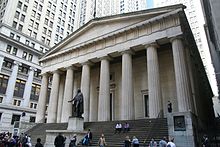
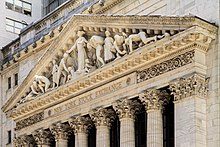
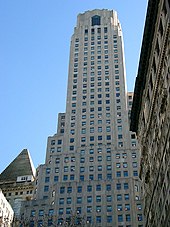
Wall Street's architecture is generally rooted in the Gilt Age.[19] The older skyscrapers oft were built with elaborate facades, which have not been common in corporate architecture for decades. There are numerous landmarks on Wall Street, some of which were erected as the headquarters of banks. These include:
- ane Wall Street, a l-story skyscraper built in 1929–1931 with an expansion in 1963–1965. Information technology was previously known every bit the Irving Trust Company Edifice and the Banking company of New York Building.[49] : xx [50]
- 14 Wall Street, a 32-story skyscraper with a 7-story stepped pyramid, congenital in 1910–1912 with an expansion in 1931–1933. It was originally the Bankers Trust Company Edifice.[49] : xx [51]
- 23 Wall Street, a four-story headquarters built in 1914, was known as the "Firm of Morgan" and served for decades every bit the J.P. Morgan & Co. banking concern's headquarters and, by some accounts, was considered an important accost in American finance. Corrective damage from the 1920 Wall Street bombing is nevertheless visible on the Wall Street side of this building.[52]
- Federal Hall National Memorial (26 Wall Street), congenital in 1833–1842. The building, which previously housed the U.s.a. Custom House and then the Subtreasury, is at present a national monument.[49] : 18 [53]
- 40 Wall Street, a 71-story skyscraper built in 1929–1930 as the Banking company of Manhattan Company Building; it later became the Trump Building.[49] : xviii [54]
- 48 Wall Street, a 32-story skyscraper built in 1927–1929 every bit the Bank of New York & Trust Visitor Edifice.[49] : xviii [55]
- 55 Wall Street, erected in 1836–1841 as the iv-story Merchants Exchange, was turned into the United States Custom House in the tardily 19th century. An expansion in 1907–1910 turned information technology into the eight-story National Urban center Bank Edifice.[49] : 17 [56]
- 60 Wall Street, congenital in 1988.[49] : 17 It was formerly the J.P. Morgan & Co. headquarters[57] before becoming the U.S. headquarters of Deutsche Bank.[58] It is the last remaining major investment banking company headquarters on Wall Street.
- 75 Wall Street, built in 1987.[59] It was built to be the U.S. headquarters of Barclays[60] although several firms leased space in the building afterwards information technology opened.[61] It was converted in 2006–2009 into a mixed-use edifice with condominiums and a hotel.[62]
Another key anchor for the area is the New York Stock Exchange Building at the corner of Broad Street. Information technology houses the New York Stock Substitution, which is by far the world's largest stock substitution per market capitalization of its listed companies,[63] [64] [65] [66] at United states$28.five trillion as of June 30, 2018.[67] Urban center regime realize its importance, and believed that it has "outgrown its neoclassical temple at the corner of Wall and Broad streets", and in 1998, offered substantial tax incentives to try to keep information technology in the Financial Commune.[15] Plans to rebuild it were delayed by the September 11 attacks.[15] The exchange nonetheless occupies the same site. The commutation is the locus for a large amount of technology and data. For instance, to adapt the three one thousand people who work directly on the commutation flooring requires 3,500 kilowatts of electricity, forth with viii,000 telephone circuits on the trading flooring alone, and 200 miles of fiber-optic cable below ground.[39]
Importance [edit]
Equally an economic engine [edit]
In the New York economic system [edit]
Finance professor Charles R. Geisst wrote that the exchange has become "inextricably intertwined into New York'due south economy".[38] Wall Street pay, in terms of salaries and bonuses and taxes, is an important part of the economic system of New York City, the tri-state metropolitan surface area, and the United States.[68] Anchored by Wall Street, New York City has been called the world's most economically powerful city and leading financial center.[69] [70] Equally such, a falloff in Wall Street'due south economy could have "wrenching effects on the local and regional economies".[68] In 2008, after a downturn in the stock market, the pass up meant $xviii billion less in taxable income, with less money bachelor for "apartments, furniture, cars, vesture and services".[68]
Estimates vary virtually the number and quality of financial jobs in the urban center. One judge was that Wall Street firms employed close to 200,000 persons in 2008.[68] Another guess was that in 2007, the financial services industry which had a $70 billion profit became 22 percent of the urban center'due south acquirement.[71] Another guess (in 2006) was that the financial services industry makes up 9% of the city'southward work forcefulness and 31% of the tax base of operations.[72] An additional gauge from 2007 by Steve Malanga of the Manhattan Institute was that the securities manufacture accounts for iv.7 percent of the jobs in New York Urban center just 20.7 percent of its wages, and he estimated there were 175,000 securities-industries jobs in New York (both Wall Street area and midtown) paying an average of $350,000 annually.[17] Between 1995 and 2005, the sector grew at an annual charge per unit of well-nigh vi.half dozen% annually, a respectable rate, but that other financial centers were growing faster.[17] Another estimate, made in 2008, was that Wall Street provided a fourth of all personal income earned in the city, and 10% of New York Metropolis's tax acquirement.[73] The metropolis's securities industry, enumerating 163,400 jobs in August 2013, continues to form the largest segment of the city's financial sector and an of import economic engine, accounting in 2012 for v percentage of individual sector jobs in New York Urban center, 8.five per centum (US$3.8 billion) of the city's taxation revenue, and 22 percent of the city's total wages, including an boilerplate salary of U.s.a.$360,700.[74]
The seven largest Wall Street firms in the 2000s were Bear Stearns, JPMorgan Hunt, Citigroup, Goldman Sachs, Morgan Stanley, Merrill Lynch and Lehman Brothers.[68] During the recession of 2008–ten, many of these firms, including Lehman, went out of business or were bought up at firesale prices by other financial firms. In 2008, Lehman filed for defalcation,[42] Bear Stearns was bought by JPMorgan Hunt[42] forced by the U.S. government,[43] and Merrill Lynch was bought by Bank of America in a similar shot-gun wedding. These failures marked a catastrophic downsizing of Wall Street as the financial industry goes through restructuring and change. Since New York'due south financial industry provides near i-fourth of all income produced in the city, and accounts for 10% of the city'southward tax revenues and 20% of the state'southward, the downturn has had huge repercussions for government treasuries.[68] New York'due south mayor Michael Bloomberg reportedly over a four-yr period dangled over $100 million in tax incentives to persuade Goldman Sachs to build a 43-story headquarters in the Financial District near the destroyed World Merchandise Heart site.[71] In 2009, things looked somewhat gloomy, with one analysis by the Boston Consulting Grouping suggesting that 65,000 jobs had been permanently lost considering of the downturn.[71] Simply in that location were signs that Manhattan belongings prices were rebounding with price rises of 9% annually in 2010, and bonuses were being paid again, with average bonuses over $124,000 in 2010.[42]
Versus Midtown Manhattan [edit]
A requirement of the New York Stock Commutation was that brokerage firms had to have offices "clustered around Wall Street" so clerks could evangelize physical newspaper copies of stock certificates each calendar week.[15] There were some indications that midtown had been becoming the locus of financial services dealings even by 1911.[75] But equally technology progressed, in the eye and later decades of the 20th century, computers and telecommunications replaced newspaper notifications, meaning that the close proximity requirement could be bypassed in more situations.[15] Many financial firms found that they could move to Midtown Manhattan, but four miles abroad,[19] and still operate finer. For instance, the one-time investment house of Donaldson, Lufkin & Jenrette was described every bit a Wall Street business firm but had its headquarters on Park Avenue in Midtown.[76] A report described the migration from Wall Street:
The financial industry has been slowly migrating from its celebrated home in the warren of streets around Wall Street to the more than spacious and glamorous office towers of Midtown Manhattan. Morgan Stanley, J.P. Morgan Hunt, Citigroup, and Bear Stearns have all moved north.
— Usa Today, October 2001.[15]
All the same, a key magnet for the Wall Street remains the New York Stock Commutation Edifice. Some "erstwhile baby-sit" firms such equally Goldman Sachs and Merrill Lynch (bought by Bank of America in 2009), have remained "fiercely loyal to the Financial District" location, and new ones such equally Deutsche Bank have called office space in the district.[xv] So-called "face up-to-face" trading between buyers and sellers remains a "cornerstone" of the NYSE, with a do good of having all of a bargain'southward players close at hand, including investment bankers, lawyers, and accountants.[fifteen]
In the New Jersey economy [edit]
After Wall Street firms started to expand w in the 1980s into New Bailiwick of jersey,[77] the straight economic impacts of Wall Street activities have gone beyond New York City. The employment in the financial services industry, mostly in the "back function" roles, has become an of import part of New Bailiwick of jersey'south economic system.[78] In 2009, the Wall Street employment wages were paid in the corporeality of nearly $xviii.5 billion in the state. The manufacture contributed $39.four billion or viii.4 pct to the New Jersey's gdp in the same year.[79]
The most significant surface area with Wall Street employment is in Bailiwick of jersey City. In 2008, the "Wall Street West" employment contributed to one third of the private sector jobs in Bailiwick of jersey City. Inside the Financial Service cluster, in that location were three major sectors: more than threescore percent were in the securities industry; twenty percentage were in banking; and 8 percent in insurance.[fourscore]
Additionally, New Jersey has become the main engineering science infrastructure to support the Wall Street operations. A substantial amount of securities traded in the United States are executed in New Jersey equally the information centers of electronic trading in the U.South. disinterestedness market for all major stock exchanges are located in Due north and Fundamental Jersey.[81] [82] A significant amount of securities immigration and settlement workforce is also in the state. This includes the majority of the workforce of Depository Trust Visitor,[83] the main U.S. securities depository; and the Depository Trust & Clearing Corporation,[84] the parent visitor of National Securities Clearing Corporation, the Fixed Income Clearing Corporation and Emerging Markets Clearing Corporation.[85]
Having a direct necktie to Wall Street employment can exist problematic for New Jersey, however. The state lost 7.9 pct of its employment base from 2007 to 2010 in the financial services sector in the fallout of the subprime mortgage crisis.[79]
Competing financial centers [edit]
Of the street's importance as a financial center, New York Times analyst Daniel Gross wrote:
In today's burgeoning and increasingly integrated global financial markets — a vast, neural spaghetti of wires, Web sites and trading platforms — the N.Y.Southward.E. is clearly no longer the epicenter. Nor is New York. The largest common-fund complexes are in Valley Forge, Pa., Los Angeles and Boston, while trading and money management are spreading globally. Since the end of the cold war, vast pools of capital take been forming overseas, in the Swiss banking concern accounts of Russian oligarchs, in the Shanghai vaults of Chinese manufacturing magnates and in the coffers of funds controlled past governments in Singapore, Russia, Dubai, Qatar and Saudi Arabia that may corporeality to some $2.5 trillion.
—Daniel Gross in 2007[17]
An example is the alternative trading platform known as BATS, based in Kansas City, which came "out of nowhere to gain a 9 percent share in the market for trading United States stocks".[17] The firm has computers in the U.S. country of New Jersey, and just two salespeople in New York City; the remaining 33 employees work in a center in Kansas.[17]
In the public imagination [edit]
As a fiscal symbol [edit]
Wall Street in a conceptual sense represents financial and economic power. To Americans, information technology tin sometimes represent elitism and ability politics, and its role has been a source of controversy throughout the nation'south history, particularly first around the Gilded Age menses in the late 19th century. Wall Street became the symbol of a state and economic system that many Americans see as having adult through merchandise, commercialism, and innovation.[86]
The term "Wall Street" has become a metonym for the financial markets of the The states every bit a whole, the American fiscal services industry, or New York–based fiscal interests.[87] [88] Wall Street has become synonymous with financial interests, often used negatively.[89] During the subprime mortgage crisis from 2007 to 2010, Wall Street financing was blamed as one of the causes, although most commentators blame an coaction of factors. The U.S. regime with the Troubled Nugget Relief Program bailed out the banks and fiscal backers with billions of taxpayer dollars, but the bailout was often criticized every bit politically motivated,[89] and was criticized by journalists as well equally the public. Analyst Robert Kuttner in the Huffington Post criticized the bailout as helping large Wall Street firms such as Citigroup while neglecting to help smaller community development banks such as Chicago's ShoreBank.[89] One writer in the Huffington Mail looked at FBI statistics on robbery, fraud, and crime and concluded that Wall Street was the "most dangerous neighborhood in the United states" if one factored in the $fifty billion fraud perpetrated by Bernie Madoff.[90]
When large firms such equally Enron, WorldCom, and Global Crossing were found guilty of fraud, Wall Street was ofttimes blamed,[30] even though these firms had headquarters effectually the nation and non in Wall Street. Many complained that the resulting Sarbanes-Oxley legislation dampened the business concern climate with regulations that were "overly burdensome".[91] Interest groups seeking favor with Washington lawmakers, such as automobile dealers, have frequently sought to portray their interests every bit allied with Main Street rather than Wall Street, although analyst Peter Overby on National Public Radio suggested that car dealers accept written over $250 billion in consumer loans and accept real ties with Wall Street.[92]
When the United States Treasury bailed out large financial firms, to ostensibly halt a down spiral in the nation'due south economy, at that place was tremendous negative political fallout, particularly when reports came out that monies supposed to exist used to ease credit restrictions were beingness used to pay bonuses to highly paid employees.[93] Analyst William D. Cohan argued that information technology was "obscene" how Wall Street reaped "massive profits and bonuses in 2009" after being saved past "trillions of dollars of American taxpayers' treasure" despite Wall Street's "greed and irresponsible risk-taking".[94] Washington Post reporter Suzanne McGee chosen for Wall Street to make a sort of public apology to the nation, and expressed dismay that people such as Goldman Sachs principal executive Lloyd Blankfein hadn't expressed contrition despite being sued by the SEC in 2009.[95] McGee wrote that "Bankers aren't the sole culprits, but their too-glib denials of responsibility and the occasional vague and waffling expression of regret don't become far enough to deflect anger."[95]
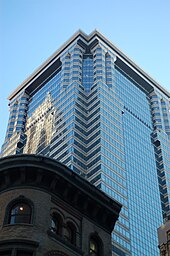
But primary banking annotator at Goldman Sachs, Richard Ramsden, is "unapologetic" and sees "banks equally the dynamos that power the rest of the economy".[42] Ramsden believes "risk-taking is vital" and said in 2010:
You can construct a banking organization in which no banking company will ever fail, in which at that place's no leverage. But there would be a cost. In that location would be virtually no economic growth because there would exist no credit creation.
—Richard Ramsden of Goldman Sachs, 2010.[42]
Others in the fiscal manufacture believe they've been unfairly castigated by the public and past politicians. For example, Anthony Scaramucci reportedly told President Barack Obama in 2010 that he felt similar a piñata, "whacked with a stick" past "hostile politicians".[42]
The fiscal misdeeds of diverse figures throughout American history sometimes casts a night shadow on financial investing every bit a whole, and include names such every bit William Duer, Jim Fisk and Jay Gould (the latter ii believed to accept been involved with an effort to collapse the U.S. golden market place in 1869) as well equally modern figures such equally Bernard Madoff who "bilked billions from investors".[96]
In add-on, images of Wall Street and its figures have loomed big. The 1987 Oliver Rock film Wall Street created the iconic figure of Gordon Gekko who used the phrase "greed is practiced", which caught on in the cultural parlance.[97] Gekko is reportedly based on multiple real-life individuals on Wall Street, including corporate raider Carl Icahn, disgraced stock trader Ivan Boesky, and investor Michael Ovitz.[98] In 2009, Rock commented how the moving-picture show had had an unexpected cultural influence, not causing them to turn away from corporate greed, but causing many young people to choose Wall Street careers because of the film.[97] A reporter repeated other lines from the film: "I'one thousand talking about liquid. Rich enough to take your own jet. Rich enough non to waste material fourth dimension. L, a hundred one thousand thousand dollars, Buddy. A actor."[97]
Wall Street firms take, however, also contributed to projects such equally Habitat for Humanity, as well as washed nutrient programs in Haiti, trauma centers in Sudan, and rescue boats during floods in People's republic of bangladesh.[99]
In pop civilization [edit]

Street sign for Wall Street at the corner with Broadway, in forepart of 1 Wall Street
- Herman Melville's classic brusque story "Bartleby, the Scrivener" (commencement published in 1853 and republished in revised edition in 1856) is subtitled "A Story of Wall Street" and portrays the alienating forces at work within the confines of Wall Street.
- Many events of Tom Wolfe's 1987 novel The Blaze of the Vanities center on Wall Street and its civilization.
- The picture show Wall Street (1987) and its sequel Wall Street: Money Never Sleeps (2010) exemplify many pop conceptions of Wall Street as a center of shady corporate dealings and insider trading.[100]
- In the Star Expedition universe, the Ferengi are said to make regular pilgrimages to Wall Street, which they worship as a holy site of commerce and concern.[101]
- On Jan 26, 2000, the band Rage Against the Auto filmed the music video for "Sleep Now in the Burn" on Wall Street, which was directed by Michael Moore.[102] The New York Stock Exchange closed early on that twenty-four hours, at two:52 p.k.[103]
- In the 2012 pic The Dark Knight Rises, Bane attacks the Gotham City Stock Exchange. Scenes were filmed in and effectually the New York Stock Exchange, with the J.P. Morgan Building at Wall Street and Wide Street standing in for the Substitution.[104]
- The 2013 picture The Wolf of Wall Street is a dark comedy about Jordan Belfort, a New York stockbroker who ran Stratton Oakmont, a house from Lake Success, New York, that engaged in securities fraud and corruption on Wall Street from 1987 to 1998.
Personalities associated with the street [edit]
Many people associated with Wall Street have get famous; although in most cases their reputations are limited to members of the stock brokerage and cyberbanking communities, others have gained national and international fame. For some, similar hedge fund manager Ray Dalio,[105] their fame is due to skillful investment strategies, financing, reporting, legal or regulatory activities, while others such equally Ivan Boesky, Michael Milken and Bernie Madoff are remembered for their notable failures or scandal.[106]
Transportation [edit]
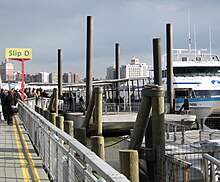
With Wall Street being historically a commuter destination, a plethora of transportation infrastructure has been adult to serve it. Pier 11 near Wall Street's eastern end is a busy terminal for New York Waterway, NYC Ferry, New York H2o Taxi, and SeaStreak. The Downtown Manhattan Heliport also serves Wall Street.
There are three New York City Subway stations nether Wall Street:
- Wall Street station at William Street (two and iii trains)[107]
- Wall Street station at Broadway (4 and 5 trains)[107]
- Broad Street station at Broad Street, with an archway at Wall Street (J and Z trains)[107]
See also [edit]
- Main Street
- K Street (Washington, D.C.)
- American business history
- Dow Jones Industrial Boilerplate
- Economy of New York Urban center
- List of Financial Districts
- Wall Street Historic District (Manhattan)
References [edit]
Notes [edit]
- ^ a b "The street on the map of Nieuw-Amsterdam".
- ^ a b "Walloons and Wallets". the loc.gov. March 2009. Retrieved September 24, 2010.
- ^ "New York and its origins".
- ^ a b c "Wall Street Timeline: From a Wooden Wall to a Symbol of Economic Power". HISTORY . Retrieved September 6, 2020.
- ^ Sidis, William James (1935). "7". The Tribes and u.s. . Retrieved November 20, 2019 – via Sidis Archives.
- ^ The History of New York Country, Book Two, Chapter II, Part 4. Editor, Dr. James Sullivan, Online Edition past Holice, Deb & Pam. Retrieved August 20, 2006.
- ^ White New Yorkers in Slave Times New-York Historical Society. Retrieved August xx, 2006. (PDF)
- ^ Timeline: A selected Wall Street chronology PBS Online. Retrieved Baronial viii, 2011.
- ^ NYSE Timeline Archived May 15, 2010, at the Wayback Car 2006 NYSE Grouping, Inc. Retrieved August 1, 2006.
- ^ a b c d e Charles R. Geisst (1997). "Wall Street: a history : from its beginnings to the autumn of Enron". Oxford University Press. ISBN0-19-511512-0 . Retrieved Jan nineteen, 2010.
- ^ Zinn, Howard (1970). The Politics of History . Boston: Buoy. pp. 67. ISBN9780252061226.
- ^ Slave Marketplace. Mapping the African American By, Columbia University.
- ^ Peter Alan Harper (February v, 2013). How Slave Labor Made New York. The Root. Retrieved April 21, 2014.
- ^ WNYC (April 14, 2015). Urban center to Acknowledge information technology Operated a Slave Market for More than Than 50 Years. WNYC. Retrieved Apr xv, 2015.
- ^ a b c d e f g h i j thou Noelle Knox and Martha T. Moor (October 24, 2001). "'Wall Street' migrates to Midtown". USA Today . Retrieved January 14, 2010.
- ^ Today in History: January 4 – The New York Stock Exchange The Library of Congress. Retrieved August 8, 2011.
- ^ a b c d e f thou h i j k l thousand Daniel Gross (October 14, 2007). "The Capital of Upper-case letter No More?". The New York Times: Magazine . Retrieved Jan 15, 2011.
- ^ "A Monument to Robert Fulton" New York Times,12 Dec 1863
- ^ a b c d Aaron Donovan (September nine, 2001). "If You're Thinking of Living In/The Financial District; In Wall Street'southward Canyons, Cliff Dwellers". The New York Times: Existent Estate . Retrieved Jan xiv, 2010.
- ^ a b Charles Dow (March 30, 2009). Laura Sether (ed.). Dow Theory Unplugged: Charles Dow's Original Editorials and Their Relevance. Due west&A Publishing. p. 2. ISBN978-1934354094.
- ^ a b "DJIA: This Month in Business organisation History (Business Reference Services, Library of Congress)". www.loc.gov . Retrieved Nov 17, 2020.
- ^ DOW JONES HISTORY – THE LATE 1800s 2006 Dow Jones & Visitor, Inc. Retrieved August 19, 2006.
- ^ "WALL STREET CLERKS FIGHT NEW STOCK Revenue enhancement; Employes in Fiscal District, Including Waiters and Lift Men, Enlisted in Movement". The New York Times. March 6, 1913. Retrieved Jan 14, 2010.
- ^ "WALL STREET P.O. BRANCH.; Postmaster General Yields to Asking of Financial District". The New York Times. March 14, 1905. Retrieved January 15, 2011.
- ^ "Show GIRLS MAKE WALL STREET RAID; They Invade Financial District and Sell Tickets for Soldiers' Relief. BROKERS Hard TO Grab Political party Welcomed at Morgan Offices, but No Sales Were Made At that place". The New York Times. July 27, 1916. Retrieved January fifteen, 2011.
- ^ Beverly Gage, The Day Wall Street Exploded: A Story of America in its Beginning Age of Terror. New York: Oxford Academy Printing, 2009; pp. 160-161.
- ^ "WALL STREET NIGHT TURNED INTO 24-hour interval". The New York Times. September 17, 1920. Retrieved January 14, 2010.
- ^ "DETECTIVES GUARD WALL ST. Against NEW BOMB OUTRAGE; Unabridged Financial District Patrolled Following AnonymousWarning to a Broker". The New York Times. December nineteen, 1921. Retrieved January 15, 2011.
- ^ a b c The earth in low 1929–1939
- ^ a b c d Larry Elliott (reviewer) Steve Fraser (author) (volume:) Wall Street: A cultural History (by Fraser) (May 21, 2005). "Going for brokers: Steve Fraser charts the highs and the lows of the world'due south financial capital in Wall Stree". The Guardian . Retrieved Jan fifteen, 2011.
- ^ a b c "STOCK Market place MARGINS: The Federal Reserve v. Wall Street". Time Mag. Baronial eight, 1960. Archived from the original on October 22, 2007. Retrieved Jan xv, 2011.
- ^ "Wall Street: Bob Cratchit Hours". Time Magazine. August eighteen, 1967. Archived from the original on December xv, 2008. Retrieved January fifteen, 2011.
- ^ a b c "WALL STREET: Assist for Broke Brokers". Fourth dimension Magazine. September 24, 1973. Archived from the original on October xviii, 2008. Retrieved January 15, 2011.
- ^ a b c "WALL STREET: Banks Equally Brokers". Fourth dimension Magazine. August 30, 1976. Archived from the original on Jan 11, 2005. Retrieved January 15, 2011.
- ^ Peter Kerr (April xviii, 1987). "AGENTS TELL OF DRUG'S GRIP ON WALL STREET". The New York Times . Retrieved January 15, 2011.
- ^ a b Michael Cooper (Jan 28, 1996). "NEW YORKERS & CO.: The Ghosts of Teapot Dome;Fabled Wall Street Offices Are At present Apartments, but Do Non Yet a Neighborhood Brand". The New York Times . Retrieved January 14, 2010.
- ^ Charles Five. Bagli (December 23, 1998). "City and State Agree to $900 Million Deal to Go along New York Stock Commutation". The New York Times . Retrieved Jan 15, 2011.
- ^ a b c Alex Berenson (October 12, 2001). "A NATION CHALLENGED: THE Commutation; Feeling Vulnerable At Heart of Wall St". The New York Times: Business Day . Retrieved January 15, 2011.
- ^ a b Leslie Eaton and Kirk Johnson (September xvi, 2001). "AFTER THE ATTACKS: WALL STREET; STRAINING TO RING THE OPENING BELL -- Subsequently THE ATTACKS: WALL STREET". The New York Times . Retrieved January fifteen, 2011.
- ^ Bruce Lambert (December 19, 1993). "NEIGHBORHOOD Report: LOWER MANHATTAN; At Job Lot, the Final Bargain Days". The New York Times . Retrieved January 14, 2010.
- ^ Blair Kamin (September 9, 2006). "How Wall Street became secure, and welcoming". Chicago Tribune . Retrieved January fourteen, 2010.
- ^ a b c d due east f thou h i Andrew Clark (October 7, 2010). "Cheerio to Wall Street: After four years equally The states business organisation correspondent, Andrew Clark is heading dwelling. He recalls the extraordinary events that most bankrupted America – and how it'due south billowy back". The Guardian . Retrieved January 15, 2011.
- ^ a b c Steve Inskeep and Jim Zarroli (March 17, 2008). "Federal Reserve Bolsters Wall Street Banks". NPR. Retrieved January xv, 2011.
- ^ Foster, Sarah. "Fed's Disbelieve Window: How Banks Borrow Money From The U.S. Central Bank". Bankrate . Retrieved September 6, 2020.
- ^ Michael Stoler (June 28, 2007). "Refashioned: Financial Commune Is Booming With Concern". New York Sun . Retrieved January 15, 2011.
- ^ Jill Jackson (June 25, 2010). "Wall Street Reform: A Summary of What's In the Beak". CBS News. Retrieved January 15, 2011.
- ^ COLIN MOYNIHAN (September 17, 2011). "Wall Street Protestation Begins, With Demonstrators Blocked". The New York Times . Retrieved September 16, 2011.
Throughout the afternoon hundreds of demonstrators gathered in parks and plazas in Lower Manhattan. They held teach-ins, engaged in discussion and debate and waved signs with messages similar "Democracy Non Corporatization" or "Revoke Corporate Personhood."
- ^ "Sandy keeps financial markets airtight Tuesday". www.cbsnews.com.
- ^ a b c d e f yard White, Norval; Willensky, Elliot & Leadon, Fran (2010). AIA Guide to New York Metropolis (fifth ed.). New York: Oxford University Press. ISBN978-0-19538-386-7.
- ^ "ane Wall Street Building" (PDF). New York Urban center Landmarks Preservation Commission. March vi, 2001. Retrieved Feb 17, 2020.
- ^ "Bankers Trust Edifice" (PDF). New York City Landmarks Preservation Committee. June 24, 1997. Retrieved Feb 17, 2020.
- ^ "Historic Structures Report: 23 Wall Street Building" (PDF). National Register of Historic Places, National Park Service. June 19, 1972. Retrieved February 17, 2020.
"J. P. Morgan & Co. Building" (PDF). New York City Landmarks Preservation Commission. December 21, 1965. Retrieved February 17, 2020. - ^ "Historic Structures Report: Federal Hall" (PDF). National Annals of Historic Places, National Park Service. October 15, 1966. Retrieved Feb 17, 2020.
"Us Custom Firm" (PDF). New York Metropolis Landmarks Preservation Committee. December 21, 1965. Retrieved February 17, 2020.
"Federal Hall Interior" (PDF). New York City Landmarks Preservation Commission. May 27, 1975. Retrieved February 17, 2020. - ^ "Historic Structures Report: Manhattan Company Building" (PDF). National Register of Historic Places, National Park Service. June 16, 2000. Retrieved Feb 17, 2020.
"Manhattan Company Edifice" (PDF). New York City Landmarks Preservation Commission. December 12, 1995. Retrieved February 17, 2020. - ^ "Celebrated Structures Written report: Bank of New York & Trust Visitor Edifice" (PDF). National Register of Historic Places, National Park Service. August 28, 2003. Retrieved Feb 17, 2020.
"Bank of New York & Trust Company Building" (PDF). New York City Landmarks Preservation Commission. October thirteen, 1998. Retrieved February 17, 2020. - ^ "Historic Structures Report: National City Banking company Building" (PDF). National Annals of Historic Places, National Park Service. November 30, 1999. Retrieved February 17, 2020.
"National Urban center Banking company Building" (PDF). New York City Landmarks Preservation Committee. December 21, 1965. Retrieved Feb 17, 2020.
"National City Bank Building Interior" (PDF). New York City Landmarks Preservation Commission. January 12, 1999. Retrieved February 17, 2020. - ^ Barbanel, Josh (September x, 1985). "Instead Of Leaving, Morgan Depository financial institution To Buy a Tower on Wall St". The New York Times. ISSN 0362-4331. Retrieved April xi, 2020.
- ^ Bagli, Charles 5. (Dec half-dozen, 2002). "Deutsche Bank Is Moving To Lower Manhattan Tower". The New York Times. ISSN 0362-4331. Retrieved April 11, 2020.
- ^ Curry, Lynne (March 12, 1987). "British companies find information technology hard to cutting big S African stakes". Christian Science Monitor. ISSN 0882-7729. Retrieved February 27, 2022.
Barclays has but completed new headquarters on Wall Street
- ^ Salpukas, Agis (April 12, 1984). "Barclay'south Will Build a Headquarters on Wall St". The New York Times. ISSN 0362-4331. Retrieved February 26, 2022.
- ^ Feldman, Amy (July 27, 1997). "Barclays may have institute new home". Crain'south New York Business. Vol. 13, no. 30. p. 9. ProQuest 219149470.
- ^ Sachmechi, Natalie (January 12, 2022). "Hakimian sells off Andaz Wall Street hotel". Crain's New York Business organisation . Retrieved February 27, 2022.
- ^ "2013 WFE Marketplace Highlights" (PDF). World Federation of Exchanges. Archived from the original (PDF) on March 27, 2014. Retrieved March 25, 2015.
- ^ "NYSE Listings Directory". Archived from the original on June 21, 2013. Retrieved June 23, 2014.
- ^ "The NYSE Makes Stock Exchanges Effectually The Earth Expect Tiny". Business Insider . Retrieved March 26, 2017.
- ^ "Is the New York Stock Exchange the Largest Stock Marketplace in the Earth?". Retrieved March 26, 2017.
- ^ "NYSE Total Market place Cap". www.nyse.com . Retrieved September 6, 2020.
- ^ a b c d e f Patrick McGeehan (July 26, 2008). "City and Country Brace for Drop in Wall Street Pay". The New York Times . Retrieved January 14, 2010.
- ^ Run into:
- Huw Jones (January 27, 2020). "New York surges alee of Brexit-adumbral London in finance: survey". Reuters. Retrieved January 27, 2020.
- Huw Jones (September four, 2018). "United states top, Uk second in financial activity: think-tank". Thomson Reuters. Retrieved September 4, 2018.
- Richard Florida (March three, 2015). "Sorry, London: New York Is the World's Nigh Economically Powerful City". Bloomberg.com. The Atlantic Monthly Group. Retrieved March 25, 2015.
Our new ranking puts the Big Apple firmly on acme.
- "Top 8 Cities by GDP: Mainland china vs. The U.Due south." Business organisation Insider, Inc. July 31, 2011. Retrieved October 28, 2015.
- "PAL sets introductory fares to New York". Philippine Airlines. Archived from the original on March 27, 2015. Retrieved March 25, 2015.
- ^ GFCI 28 Rank Accessed September 26, 2020.
- ^ a b c Patrick McGeehan (February 22, 2009). "After Reversal of Fortunes, City Takes a New Await at Wall Street". The New York Times . Retrieved January xv, 2011.
- ^ Heather Timmons (October 27, 2006). "New York Isn't the World'southward Undisputed Financial Capital". The New York Times . Retrieved Jan 15, 2011.
- ^ Patrick McGeehan (September 12, 2008). "As Fiscal Empires Shake, City Feels No. 2 on Its Heels". The New York Times . Retrieved January xv, 2011.
- ^ Thomas P. DiNapoli (New York State Comptroller) and Kenneth B. Bleiwas (New York State Deputy Comptroller) (Oct 2013). "The Securities Industry in New York City" (PDF) . Retrieved July xxx, 2014.
- ^ "WALL STREET BANKS CONNECTING UPTOWN; Fiscal District Notes This as American Exchange National Buys Into the Pacific". The New York Times. May 27, 1911. Retrieved January 14, 2010.
- ^ Heidi N. Moore (March 10, 2008). "DLJ: Wall Street'south Incubator". The Wall Street Journal . Retrieved January 14, 2010.
- ^ Williams, Winston (Oct 28, 1988). "On the Bailiwick of jersey City Docks, Wall St. West". The New York Times . Retrieved June 28, 2013.
- ^ Scott-Quinn, Brian (July 31, 2012). Finance, investment cyberbanking and the international bank credit and capital markets : a guide to the global industry and its governance in the new age of dubiety. Houndmills, Basingstoke: Palgrave Macmillan. p. 66. ISBN978-0230370470 . Retrieved June 29, 2013.
- ^ a b "Finance". New Jersey Next Stop ... Your Career. State of New Jersey. Retrieved June 29, 2013.
- ^ "Your Gateway to Opportunity, Enterprise Zone Five Year Strategic Program 2010" (PDF). Jersey Metropolis Economic Development Corporation. Archived from the original (PDF) on October 28, 2013. Retrieved June 29, 2013.
- ^ Bowley, Graham (January 1, 2011). "The New Speed of Coin, Reshaping Markets". The New York Times . Retrieved June 29, 2013.
- ^ "NASDAQ OMX Express Connect" (PDF). NASDAQ OMX. Retrieved June 29, 2013.
- ^ "DTC Operations Move to Newport, New Jersey" (PDF). The Depository Trust Company. September x, 2012. Retrieved June 29, 2013.
- ^ Gregory, Bresiger (December 14, 2012). "DTCC Moves Most Operations to NJ". Traders Magazine . Retrieved June 29, 2013.
- ^ "Clearing Agencies". U.S. Securities and Commutation Commission. Retrieved June 29, 2013.
- ^ Fraser (2005).
- ^ Investing, Full Bio Follow Twitter Joshua Kennon co-authored "The Consummate Idiot's Guide to; Edition", 3rd; Kennon, runs his own asset management house for the affluent Read The Balance's editorial policies Joshua. "Larn how Wall Street works". The Rest . Retrieved September 6, 2020.
- ^ Merriam-Webster Online Archived Oct 12, 2007, at the Wayback Machine, retrieved July 17, 2007.
- ^ a b c Robert Kuttner (Baronial 22, 2010). "Zillions for Wall Street, Zippo for Barack's Old Neighborhood". Huffington Post . Retrieved January xiv, 2010.
- ^ B. Jeffrey Madoff (March 10, 2009). "The Almost Dangerous Neighborhood in the U.s.a.". Huffington Post . Retrieved Jan 14, 2010.
- ^ Daniel Altman (September 30, 2008). "Other financial centers could rise amidst crunch". The New York Times: Business . Retrieved January 15, 2011.
- ^ Peter Overby (June 24, 2010). "Car Dealers May Escape Scrutiny Of Consumer Loans". NPR. Retrieved January 14, 2010.
- ^ "Hard Times, But Large Wall Street Bonuses". CBS News. November 12, 2008. Retrieved January 14, 2010.
- ^ William D. Cohan (April 19, 2010). "You're Welcome, Wall Street". The New York Times . Retrieved January xv, 2011.
- ^ a b Suzanne McGee (June 30, 2010). "Will Wall Street ever repent?". Washington Post . Retrieved January xv, 2011.
- ^ T.L. Chancellor (January 14, 2010). "Walking Tours of NYC". USA Today: Travel. Retrieved January fourteen, 2010.
- ^ a b c Tim Arango (September 7, 2009). "Greed Is Bad, Gekko. So Is a Meltdown". The New York Times: Movies . Retrieved Jan 14, 2010.
- ^ Chen, James. "Who Is Gordon Gekko?". Investopedia . Retrieved September 6, 2020.
- ^ Emily Wax (October 11, 2008). "Wall Street Greed? Not in This Neighborhood". Washington Post . Retrieved January 14, 2010.
- ^ IMDb entry for Wall Street Retrieved August nineteen, 2006.
- ^ 11:59 (Star Trek: Voyager)
- ^ Basham, David (Jan 28, 2000). "Rage Against The Machine Shoots New Video With Michael Moore". MTV News . Retrieved September 24, 2007.
- ^ "NYSE special closings since 1885" (PDF). Archived from the original (PDF) on September 25, 2007. Retrieved September 24, 2007.
- ^ Reeves, Tony. "Filming Locations for Christopher Nolan's The Dark Knight Rises (2012), with Christian Bale, in New York, Pittsburgh, Los Angeles, the UK and India".
- ^ "Ray Dalio". Forbes . Retrieved September 6, 2020.
- ^ John Steele Gordon "Wall Street's x Most Notorious Stock Traders," American Heritage, Spring 2009.
- ^ a b c "Subway Map" (PDF). Metropolitan Transportation Say-so. September 2021. Retrieved September 17, 2021.
Other sources [edit]
- Atwood, Albert W. and Erickson, Erling A. "Morgan, John Pierpont, (April 17, 1837 – March 31, 1913)," in Dictionary of American Biography, Volume 7 (1934)
- Caplan, Sheri J. Petticoats and Pinstripes: Portraits of Women in Wall Street's History. Praeger, 2013. ISBN 978-1-4408-0265-two
- Carosso, Vincent P. The Morgans: Private International Bankers, 1854–1913. Harvard University Press, 1987. 888 pp. ISBN 978-0-674-58729-viii
- Carosso, Vincent P. Investment Banking in America: A History Harvard University Press (1970)
- Chernow, Ron. The House of Morgan: An American Banking Dynasty and the Rise of Modernistic Finance, (2001) ISBN 0-8021-3829-2
- Fraser, Steve. Every Human a Speculator: A History of Wall Street in American Life HarperCollins (2005)
- Geisst, Charles R. Wall Street: A History from Its Ancestry to the Fall of Enron. Oxford University Press, 2004. online edition
- Jaffe, Stephen H. & Lautin, Jessica. Upper-case letter of Upper-case letter: Money, Banking, and Power in New York City, 1784–2012 (2014)
- Moody, John. The Masters of Capital: A Chronicle of Wall Street Yale University Press, (1921) online edition
- Morris, Charles R. The Tycoons: How Andrew Carnegie, John D. Rockefeller, Jay Gould, and J. P. Morgan Invented the American Supereconomy (2005) ISBN 978-0-8050-8134-3
- Perkins, Edwin J. Wall Street to Main Street: Charles Merrill and Heart-class Investors (1999)
- Sobel, Robert. The Large Lath: A History of the New York Stock Market place (1962)
- Sobel, Robert. The Smashing Bull Market: Wall Street in the 1920s (1968)
- Sobel, Robert. Inside Wall Street: Continuity & Change in the Financial District (1977)
- Strouse, Jean. Morgan: American Financier. Random House, 1999. 796 pp. ISBN 978-0-679-46275-0
- Finkelman, Paul. Encyclopedia of African American History 1896 to the nowadays. Oxford University Press Inc, (2009)
- Kindleberger, Charles. The earth in Depression 1929–1939. Berkeley and Los Angeles: University of California Press, (1973)
- Gordon, John Steele. The Great Game: The Emergence of Wall Street as a World Power: 1653–2000. Scribner, (1999)
External links [edit]
Route map:
KML is from Wikidata
-
 Media related to Wall Street at Wikimedia Commons
 - New York Songlines: Wall Street, a virtual walking tour
jenningsoppoichest.blogspot.com
Source: https://en.wikipedia.org/wiki/Wall_Street
0 Response to "Make America Great Again Build the Wall"
Post a Comment